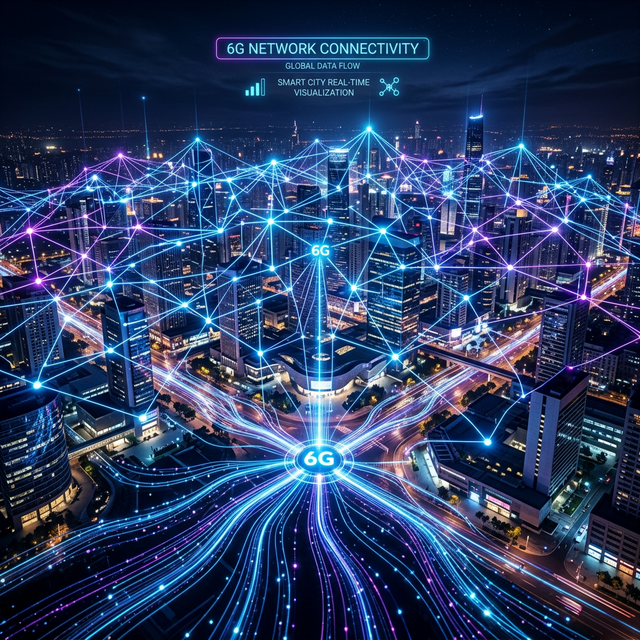
The next big leap in global connectivity has officially begun. While many regions have just comfortably adopted 5G, the global telecommunications giants have already set their sights on the future: 6G Connectivity.
In 2026, we are witnessing the first monumental shifts towards 6G network capabilities. It promises data speeds hundreds of times faster than 5G, microscopic latency rates, and a complete reimagining of what our digital infrastructure can support. If you thought streaming 4K video instantly was the peak of mobile networking, prepare to be amazed. Let's explore exactly what 6G means for businesses, creators, and everyday digital consumers.
1. 6G vs. 5G: What is the Real Difference?
To put 6G into perspective, we must look at what it replaces. 5G was largely about providing stable, fast internet (up to 10-20 Gbps) and supporting the explosion of IoT (Internet of Things) devices like smart home locks and smartwatches.
6G steps into an entirely new dimension of data transfer. Expect peak data rates hitting 1 Terabit per second (Tbps). This massive jump is achieved by utilizing the Terahertz (THz) spectrum—frequencies much higher than the millimeter waves used by 5G.
- Speed: 6G is projected to be 100 to 500 times faster than average 5G networks.
- Latency: While 5G achieved latency of roughly 1 millisecond, 6G is targeting microsecond latency—essentially real-time communication with zero perceptible delay.
- Device Density: A 6G node can support up to 10 million devices per square kilometer, compared to 5G's 1 million.
2. The True Enabler of "The Metaverse" and XR
For years, tech companies touted "The Metaverse" and Extended Reality (XR)—the blending of Augmented, Virtual, and Mixed Realities—but the physical network infrastructure struggled to support the immense graphical data transfer required seamlessly.
With 6G, the bottleneck is removed.
- Holographic Communication: High-definition, volumetric holographic video calls are becoming a reality instead of a gimmick. The micro-latency of 6G handles the immense data stream required to project 3D avatars instantly perfectly.
- Immersive Cloud Gaming: Games pushing photorealism can be streamed directly to lightweight AR glasses without any lag, rendering high-end gaming consoles all but obsolete.
3. AI-Native Networks
One of the foundational differences in 2026 is that 6G isn't just a network that supports AI; it is an AI-Native Network.
This means Artificial Intelligence is baked directly into the edge and core of the telecom architecture. The network intelligently manages its own bandwidth, predicting traffic spikes before they happen, and re-routing data packets instantly to prevent congestion. It self-optimizes, self-heals in the event of hardware failures, and drastically reduces power consumption during low-usage hours.
4. The Transformation of Smart Cities and Automation
Because 6G allows millions of sensors to communicate instantly across a hyper-dense area, the concept of a "Smart City" is finally coming to true fruition.
- Autonomous Transportation: Self-driving vehicles require constant, split-second communication with the road infrastructure, other cars, and pedestrians to be truly safe. 6G's micro-latency is the missing puzzle piece for widespread Level 5 Autonomous driving.
- Remote Medical Procedures: Surgeons can operate on patients halfway across the world using highly responsive robotic arms, trusting the network's zero latency and hyper-reliability to safely conduct delicate maneuvers.
5. Bridging the Digital Divide (Non-Terrestrial Networks)
A crucial part of the 6G standard rollout involves deep integration with Non-Terrestrial Networks (NTN). This means low-Earth orbit (LEO) satellites and high-altitude platform stations (HAPS) are built into the 6G ecosystem from day one.
This is revolutionary because it promises high-speed, 6G-level internet access not just in dense urban hubs, but in rural communities, across oceans, and in airplanes. It is a massive leap forward for global digital equity.
Final Thoughts: Embracing the Speed of Tomorrow
The dawn of 6G in 2026 is more than just faster downloads. It is an infrastructural paradigm shift that will dictate how humanity interacts with the digital world for the next decade. As this technology scales globally over the coming years, we will see the lines between the physical and digital realities blur in ways previously relegated to science fiction.
Prepare your businesses and skillsets for a hyper-connected, instantaneously responsive world.

Samuel is a technology educator and web strategist with 8+ years of experience helping developers, students, and creators navigate the digital world with practical, beginner-friendly guides.