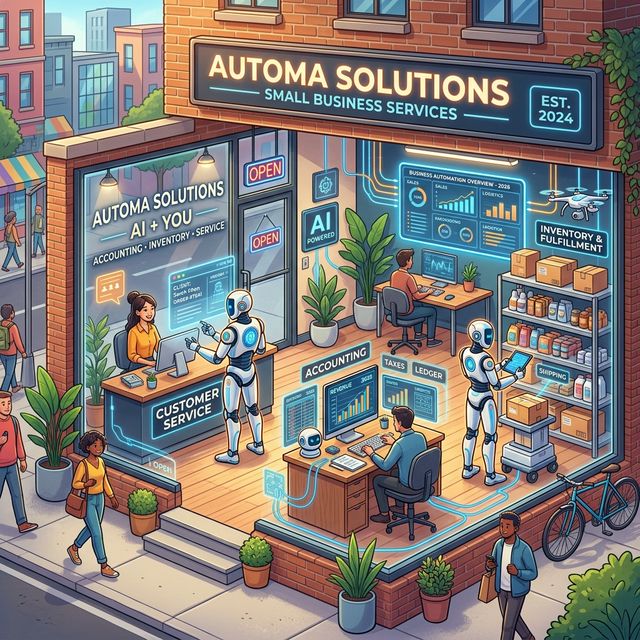
Running a small business frequently feels like trying to juggle chainsaws while balancing on a tightrope. You are the CEO, the head of marketing, the customer support specialist, and the accounting department all rolled into one. For years, the only way to scale and offload these tasks was to hire more employees. But in 2026, there is a vastly more efficient, cost-effective solution: Artificial Intelligence.
AI automation is no longer an enterprise-level luxury reserved for tech giants with massive budgets. It has become accessible, affordable, and incredibly easy to implement for businesses of any size. By automating the repetitive, manual tasks that drain your energy, you can focus on what truly matters—growing your business, innovating your products, and serving your customers better.
In this guide, we will break down exactly how AI can automate different areas of your small business, the best tools to use in 2026, and practical steps to implement these technologies without getting overwhelmed.
1. AI in Customer Support: 24/7 Service Without the Overhead
Customer expectations are higher than ever. If a potential customer messages your Instagram page at 2:00 AM asking about shipping times, they expect a nearly instant response. If you don't answer, they go to your competitor.
How Automation Helps
AI chatbots have evolved significantly from the rigid, frustrating "press 1 for sales" bots of the past. Modern Conversational AI connects directly to your business data, website FAQs, and inventory systems to provide human-like, accurate responses instantly.
- Instant Query Resolution: AI can instantly answer questions like "What are your business hours?", "How do I return an item?", or "Is this product in stock?"
- Lead Qualification: An AI bot can ask prospective clients qualifying questions, collect their email addresses, and automatically book an appointment on your calendar.
- Multi-language Support: Instantly translate inquiries and reply in the customer's native language.
Recommended AI Tools
- Chatbase or Dante AI: Allow you to upload a PDF of your company data, link your website, and generate a custom GPT chatbot in 5 minutes.
- ManyChat: Incredible for automating Instagram and Facebook Messenger interactions dynamically.
Actionable Tip
Set up an Instagram auto-reply using ManyChat. When a user comments a specific keyword (e.g., "DISCOUNT") on your post, the AI automatically sends them a DM with a promo code and a link to your store.
2. Accounting and Bookkeeping Automation
Unless you started a bookkeeping firm, you probably didn't start your business to stare at spreadsheets and chase down receipts. Yet, financial administration is a massive time sink for most entrepreneurs.
How Automation Helps
AI has fundamentally shifted how small businesses manage money. AI bookkeeping software can connect to your business bank accounts and automatically categorize expenses according to tax codes.
- Invoice Scanning: AI-powered Optical Character Recognition (OCR) tools can scan a crumpled receipt, extract the vendor, date, amount, and tax info, and input it neatly into your ledger.
- Automated Invoicing & Follow-ups: The system automatically generates invoices for recurring clients and sends polite, AI-drafted follow-up emails when payments are overdue.
- Cash Flow Forecasting: AI analyzes your past transaction data to predict when cash flow might be tight, allowing you to prepare in advance.
Recommended AI Tools
- QuickBooks Online (Advanced AI features): Automatically categorizes transactions and flags anomalies.
- Dext (formerly Receipt Bank): Captures and categorizes receipts instantly via an AI mobile app.
3. Marketing and Content Creation on Autopilot
Consistency is the key to marketing success, but creating fresh, engaging content every single day—blogs, social media posts, newsletters—is exhausting.
How Automation Helps
Generative AI acts as your in-house marketing agency. It can generate ideas, draft copy, design graphics, and even schedule the content for you.
- Social Media Management: AI tools can analyze your past, high-performing posts, figure out why they worked, and generate similar content tailored for different platforms (LinkedIn, X, Instagram).
- Email Marketing: Send hyper-personalized email campaigns based on customer behavior. If a customer leaves an item in their cart, the AI automatically drafts an email with a 10% discount and compelling copy to push the sale.
- SEO Blogging: Use AI to outline, draft, and optimize highly searchable blog articles to drive organic traffic to your website.
Recommended AI Tools
- Jasper AI: Built specifically to maintain your brand voice across ads, blogs, and social media.
- Canva Magic Studio: Automatically generates stunning visual graphics based on a text prompt and resizes them for every social platform.
- Klaviyo / Mailchimp AI: For automated, behavior-triggered email marketing.
Best Practice
Never copy and paste AI content directly. Let the AI generate the first draft (the "ugly first draft"), and then spend 15 minutes injecting your personal stories, brand personality, and distinct opinion into the text. AI provides the structure; you provide the soul.
4. Streamlining HR, Hiring, and Onboarding
Scaling your team is essential for growth, but the hiring process—sifting through resumes, scheduling interviews, and training new hires—can bring operations to a halt.
How Automation Helps
From the moment you need to open a job position to the employee's first day, AI handles the heavy lifting.
- Resume Screening: AI Applicant Tracking Systems (ATS) scan hundreds of resumes in seconds, highlighting the candidates whose skills best match the job description.
- Interview Scheduling: AI assistants sync with your calendar and email candidates to find a mutual time for an interview, completely eliminating the painful back-and-forth emails.
- Automated Onboarding: When a new employee joins, an AI bot can instantly generate their corporate email, assign them to the correct Slack channels, and send them an interactive onboarding training module.
Recommended AI Tools
- Breezy HR: Offers excellent AI candidate matching and automated scheduling.
- Scribe: Automatically generates step-by-step training manuals and SOPs (Standard Operating Procedures) just by watching you click through a process on your computer.
5. Inventory and Supply Chain Management
For small e-commerce or retail businesses, inventory mismanagement is fatal. Ordering too much ties up cash; ordering too little results in stockouts and angry customers.
How Automation Helps
AI takes the guesswork out of purchasing. It analyzes historical sales data, seasonal trends, current marketing campaigns, and even local weather patterns to predict exactly how much stock you need.
- Demand Forecasting: The AI predicts a surge in demand for a specific product before it happens.
- Automated Purchase Orders: When stock drops below the AI-determined threshold, the system automatically drafts and sends a purchase order to your supplier.
- Dynamic Pricing: AI can adjust your prices in real-time based on competitor pricing and demand elasticity, maximizing your profit margins automatically.
Step-by-Step Guide to Implementing AI in Your Business Today
Implementing AI shouldn't feel like you are rebuilding your business from scratch. It should be an iterative, calm process. Follow these steps:
Step 1: Identify the Workflow Bottlenecks
Take a notepad and write down everything you do in a week. Highlight the tasks that are: 1. Highly repetitive 2. Time-consuming 3. Don't require complex strategic thinking These are your prime candidates for automation.
Step 2: Choose One Process to Start
Do not attempt to automate customer service, accounting, and marketing all on the same day. Pick the biggest bottleneck. If answering customer DMs takes you 3 hours a day, start with a chatbot.
Step 3: Test and Monitor
Implement the software and monitor it closely for two weeks. If you set up an AI chatbot, read the transcripts of its conversations to ensure it sounds polite and accurate. If you use AI accounting, double-check its categorizations.
Step 4: Standardize and Scale
Once the first AI implementation is running smoothly without your intervention, write an SOP (Standard Operating Procedure) for how it works. Then, move on to the next bottleneck on your list.
Conclusion
The businesses that will thrive in 2026 and beyond are not necessarily the ones with the best funding, but the ones with the highest operational efficiency. AI is the great equalizer, allowing a 3-person startup to execute with the speed, presence, and professionalism of a 50-person corporation.
There is no "perfect" time to start automating. The tools are available, accessible, and ready to take on the busywork so that you can get back to building the vision of your small business. Start small, automate one task today, and reclaim your time.

Samuel is a technology educator and web strategist with years of experience helping professionals navigate the evolving digital and artificial intelligence landscape with practical, actionable guides.