The computational landscape of the world is shifting fast. What was once confined to highly protected, sub-zero laboratories in the world's most elite research facilities—Quantum Computing—is beginning to bleed into everyday technological ecosystems in 2026.
For the longest time, the average digital user thought quantum tech was purely science fiction, or at least decades away from consumer relevance. However, recent breakthroughs in quantum error correction and hybrid quantum-classical cloud computing have pushed this futuristic technology much closer to the smartphones, laptops, and networks we use daily. This comprehensive guide will explore how quantum computing is merging with everyday technology, why it's a massive tech trend, and what it means for your digital future.
1. Understanding the Quantum Shift
To grasp the magnitude of this shift, we must first understand the basics. Traditional computers (like the device you are using to read this) operate on bits—which represent information as either a 0 or a 1. Every photograph, website, and software program is essentially millions of 1s and 0s processed rapidly.
Quantum computers, however, use qubits. Thanks to the strange rules of quantum mechanics (superposition and entanglement), a qubit can be a 0, a 1, or both at exactly the same time. This fundamental difference means quantum computers don't just solve problems a little faster; they solve complex problems exponentially faster. What would take a traditional supercomputer 10,000 years to figure out, a mature quantum computer might solve in minutes.
2. The Rise of "Hybrid Computing" in 2026
Will you have a quantum computer on your desk by the end of the year? No. The hardware still requires absolute zero temperatures (-273°C) and extreme isolation from environmental noise. However, how you interact with them has fundamentally changed.
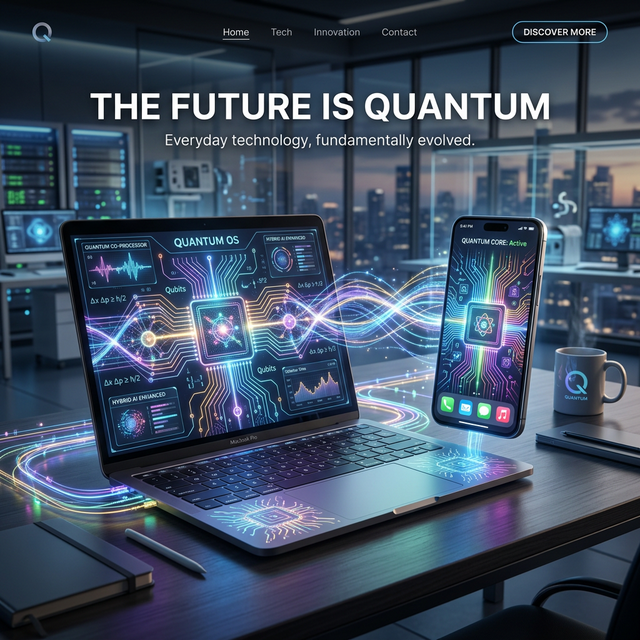
Enter Hybrid Cloud-Quantum Computing. Major tech companies have successfully integrated quantum processing units (QPUs) into their massive cloud networks (like AWS, Google Cloud, and Azure). When you run certain complex apps on your laptop or smartphone, the classical processors handle the basic UI and everyday tasks, while the extraordinarily complex calculations are silently outsourced to a quantum server in the cloud, returning the answer in milliseconds.
- Cloud Access: Developers can now seamlessly call quantum APIs just as easily as they call standard web services.
- Quantum Algorithms everywhere: The software running your logistics apps, financial portfolios, and even high-end gaming AI are beginning to tap into quantum optimization.
3. The "Quantum-AI" Super-Merger
One of the most thrilling developments of 2026 is the direct synergy between Artificial Intelligence and Quantum Computing—a field known as Quantum Machine Learning (QML).
Training advanced AI models like ChatGPT, Gemini, or Claude requires processing mountains of data. It takes enormous time and energy on classical hardware. Quantum computers excel at finding patterns within massively complex datasets simultaneously.
- Faster AI Training: Quantum-assisted algorithms are drastically reducing the time it takes to train billion-parameter AI models.
- More Accurate Predictions: From weather forecasting to financial modeling, Quantum AI provides more nuanced and highly accurate predictive outcomes.
- Pharmaceuticals: Simulating molecular interactions for drug discovery, a process known to be notoriously taxing, is now seeing breakthrough speed thanks to QML.
4. What This Means for Everyday Consumers
While the heavy lifting is done in the cloud, the ripple effects are reaching everyday consumers in very tangible ways:
- Hyper-Personalization: Because QML can process significantly more variables instantly, the AI curation in streaming algorithms, e-commerce recommendations, and smart home IoT networks acts more "intelligent" and intuitively aligned with your habits.
- Unbreakable Security... Pending: Because quantum computers could theoretically break classical encryption (RSA), 2026 has heralded the massive adoption of Post-Quantum Cryptography (PQC). Your banking apps, messaging platforms, and digital wallets are quietly upgrading their encryption to be "Quantum-Safe."
- Superior Battery Chemistry: Quantum simulations are helping engineers discover entirely new material composites. The result? The batteries in newer EV cars and flagship smartphones are becoming lighter, charging faster, and holding power significantly longer.
5. The Road Ahead: Overcoming the Noise
Quantum computing in 2026 is not perfect. The biggest hurdle remains "Quantum Noise"—the tendency for qubits to lose their delicate state due to minute environmental disturbances. However, tech giants are making huge leaps in Logical Qubits (grouping many flawed physical qubits together to act as one perfect, reliable qubit).
Final Thoughts: A New Technological Era
The convergence of quantum processing power, generative AI, and high-speed cloud networks in 2026 is setting the stage for the next great leap in human innovation.
You may never physically touch a qubit, but its power is now woven into the fabric of the digital world. The software you use, the security protecting your data, and the AI assistants you rely on are all being leveled up by the weird, wonderful world of quantum mechanics. Understanding this shift is the first step to thriving in the post-classical computing era.

Samuel is a technology educator and web strategist with 8+ years of experience helping developers, students, and creators navigate the digital world with practical, beginner-friendly guides.