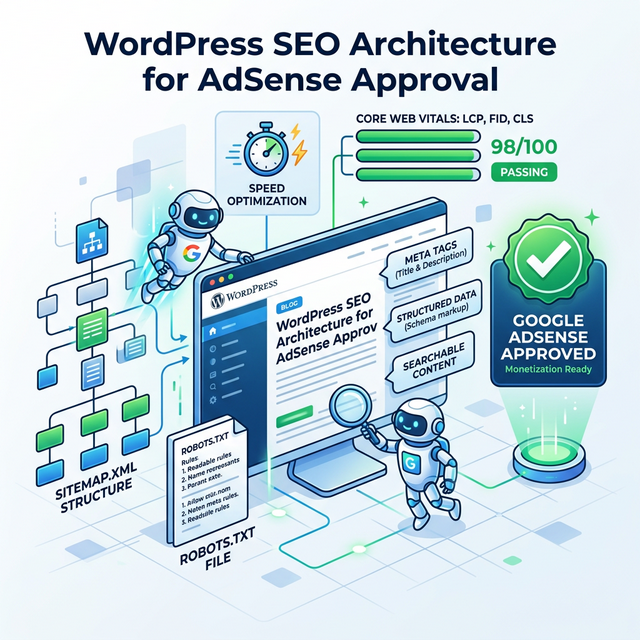
Building a WordPress site is easy, but architecting it for top-tier publishers takes targeted expertise. If your goal is generating revenue through Google AdSense, a beautifully wrapped presentation isn't enough. You must implement advanced smart tips and technical SEO architecture structures to ensure lightning-fast indexing and impeccable web monetization.
To dominate the global search engine space and conquer highly competitive keywords like "smart things", we must talk about the underlying technical setup of your site. This includes properly structuring your robots.txt to save crawler budget, engineering precise sitemaps, dominating Core Web Vitals, and implementing the exact metadata schemas Google requires.
The Problem with Standard WordPress Installs
By default, WordPress is incredibly bloated. It loads excessive scripts (like jQuery) everywhere, generates unnecessary thin content pages (like author archives and tag pages with overlapping posts), and fails out of the box to guide search engine bots correctly. This creates immense "keyword cannibalization" and wastes Google's crawler budget, meaning your best posts get indexed late, or sometimes not at all.
The secret that elite publishers use for web monetization revolves around strictly isolating and controlling every aspect of the site's footprint. The more efficiently Google navigates and understands your site's hierarchy, the faster it will rank you in its index.
1. Architecting Your robots.txt for "Crawler Budget"
Think of your crawler budget as how much time the Googlebot is willing to spend looking at your site per day. If it gets distracted reading useless tag archive pages, your brand-new, high-value articles won't get indexed.
Essential Publisher robots.txt Configuration
You must actively disallow Google from rendering thin utility directories while simultaneously prioritizing the paths handling your core content.
User-agent: *
Disallow: /wp-admin/
Disallow: /wp-login.php
Disallow: /?s=
Disallow: /search/
Disallow: /author/
Disallow: /tag/
Allow: /wp-admin/admin-ajax.php
Sitemap: https://www.yourdomain.com/sitemap_index.xml
This specific setup prevents indexing of internal search results pages—a critical requirement for AdSense policy compliance, as search spam severely drops site quality.
2. Perfecting the Structure: Sitemap.xml
Most default sitemaps dump every image, tag, and obsolete category onto a massive list. As a publisher, you must streamline your XML sitemap:
- Exclude Tag Sitemaps: Tags rarely rank over posts and they dilute the domain focus.
- Split Sitemaps: Employ hierarchical sitemap indexes (e.g., `sitemap_index.xml` separating `post-sitemap.xml` and `page-sitemap.xml`). This allows Google to parse updates individually instead of rescanning one massive list.
- Use 'lastmod' Attributes Diligently: Ensure your sitemap generates immediate `<lastmod>` updates the second you edit an article. This flags Google instantly the moment you hit publish or polish existing content.
3. Conquering Core Web Vitals for AdSense
Google heavily correlates AdSense performance with Core Web Vitals (CWV)—notably Largest Contentful Paint (LCP), Interaction to Next Paint (INP), and Cumulative Layout Shift (CLS). You cannot achieve AdSense approval if your site jags and jumps whenever an ad block partially loads.
- Aggressive Caching: Use caching mechanisms (like Redis Object Cache combined with edge CDN caching) that deliver fully rendered HTML directly, drastically dropping Time-to-First-Byte (TTFB).
- Reserve Space for Ads (CLS Avoidance): Explicitly specify the height and width of your AdSense container `<div>` tags in your CSS. If AdSense hasn't filled the slot yet, the page layout won't magically shift when the ad finally appears. Layout shifts result in immediate CWV rejection.
- Defer Off-Screen Scripts: Employ plugins or server configurations to defer secondary CSS and non-critical JS. Only load Google Analytics and social scripts when a user interacts or scrolls past the hero section.
4. Proper Metadata Execution
Deploying exact, structured meta is how you rank globally and win on massive keywords. Simply stuffing words isn't enough; you must leverage JSON-LD Schema markup. If an article is a tutorial, you should dynamically inject `HowTo` schema. If it's news, `NewsArticle` schema.
Furthermore, managing custom metadata manually guarantees you own the presentation layer.
Hard-coding targeted long-tail structures (like utilizing specific
geo.region tracking tags for global reach) communicates profound intent to
international search hubs, increasing global impressions radically compared to
out-of-the-box SEO plugins.
Conclusion
Passing AdSense policies and achieving rapid indexing isn't alchemy—it's a very rigid, technical engineering process. By restricting your SEO footprints with strict robots.txt rules, refining your sitemap priorities, conquering your Core Web Vitals, and meticulously handling your schemas, you prepare your WordPress platform identically to how the most successful, revenue-generating digital media empires run.
Apply these top-class technical architectures, integrate these powerful smart things today, and watch as your AdSense approval flies through—and your latest articles hit Google's first page instantly.